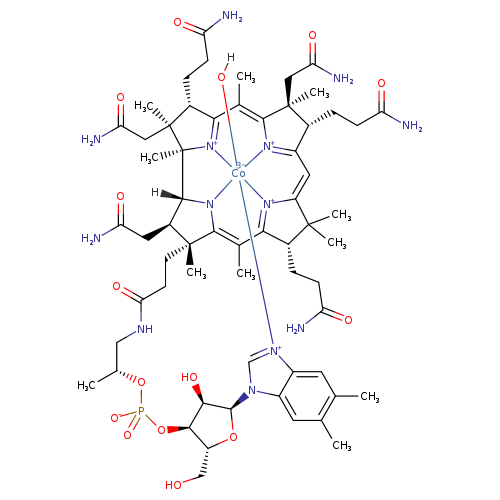
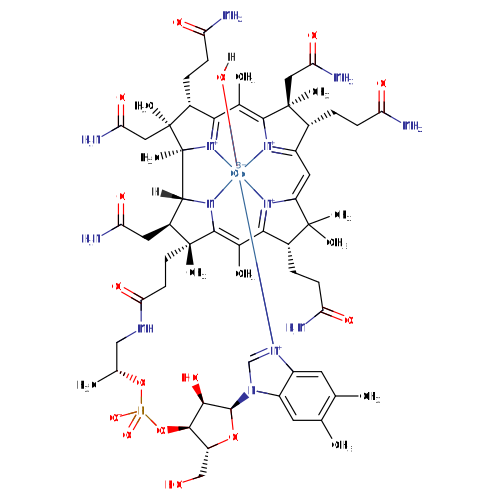
Record Information
Version1.0
Creation Date2009-03-22 21:40:18 UTC
Update Date2026-04-05 16:12:17 UTC
Accession NumberCHEM000604
Identification
Common NameHydroxocobalamin
ClassSmall Molecule
DescriptionHydroxocobalamin is only found in individuals that have used or taken this drug.It is an injectable form of vitamin B 12 that has been used therapeutically to treat vitamin B 12 deficiency. [PubChem]
Contaminant Sources
  • FooDB Chemicals
  • HMDB Contaminants - Urine
  • IARC Carcinogens Group 2B
  • T3DB toxins
Contaminant Type
  • Amide
  • Amine
  • Anti-Anemic Agent
  • Cobalt Compound
  • Drug
  • Ether
  • Food Toxin
  • Hematinic
  • Metabolite
  • Natural Compound
  • Nutritional Supplement
  • Nutritional Support
  • Organic Compound
  • Pollutant
  • Vitamin B Complex
Chemical Structure
Thumb
Synonyms
ValueSource
HydroxycobalaminChEBI
OH-CBLChEBI
Vitamin b-12bChEBI
HydroxominHMDB
Hydroxo-cobalaminHMDB
a-(5,6-Dimethylbenzimidazolyl)hydroxocobamideHMDB
alpha CobioneHMDB
alpha-(5,6-Dimethylbenzimidazolyl)hydroxocobamideHMDB
AxlonHMDB
Ciplamin HHMDB
CobalexHMDB
Cobalin HHMDB
Cobinamide hydroxide phosphate 3'-ester with 5,6-dimethyl-1-a-D-ribofuranosylbenzimidazole inner saltHMDB
Cobinamide hydroxide phosphate 3'-ester with 5,6-dimethyl-1-alpha-delta-ribofuranosylbenzimidazole inner saltHMDB
CodroxominHMDB
DocclanHMDB
DocelanHMDB
DocevitaHMDB
DroxominHMDB
Ducobee hyHMDB
DuradoceHMDB
Duralta-12HMDB
HydrocobalaminHMDB
HydrogrisevitHMDB
HydrovitHMDB
HydroxocobalamineHMDB
HydroxocobalaminHMDB
Chemical FormulaC62H89CoN13O15P
Average Molecular Mass1346.355 g/mol
Monoisotopic Mass1345.567 g/mol
CAS Registry Number13422-51-0
IUPAC Name(10S,12R,13S,17R,23R,24R,25R,30S,35S,36S,40S,41S,42R,46R)-30,35,40-tris(2-carbamoylethyl)-24,36,41-tris(carbamoylmethyl)-1,46-dihydroxy-12-(hydroxymethyl)-5,6,17,23,28,31,31,36,38,41,42-undecamethyl-15,20-dioxo-11,14,16-trioxa-2lambda5,9,19,26,43lambda5,44lambda5,45lambda5-heptaaza-15lambda5-phospha-1-cobaltadodecacyclo[27.14.1.1^{1,34}.1^{2,9}.1^{10,13}.0^{1,26}.0^{3,8}.0^{23,27}.0^{25,42}.0^{32,44}.0^{39,43}.0^{37,45}]heptatetraconta-2(47),3,5,7,27,29(44),32,34(45),37,39(43)-decaene-2,43,44,45-tetrakis(ylium)-1,1,1-triuid-15-olate
Traditional Name(10S,12R,13S,17R,23R,24R,25R,30S,35S,36S,40S,41S,42R,46R)-30,35,40-tris(2-carbamoylethyl)-24,36,41-tris(carbamoylmethyl)-1,46-dihydroxy-12-(hydroxymethyl)-5,6,17,23,28,31,31,36,38,41,42-undecamethyl-15,20-dioxo-11,14,16-trioxa-2lambda5,9,19,26,43lambda5,44lambda5,45lambda5-heptaaza-15lambda5-phospha-1-cobaltadodecacyclo[27.14.1.1^{1,34}.1^{2,9}.1^{10,13}.0^{1,26}.0^{3,8}.0^{23,27}.0^{25,42}.0^{32,44}.0^{39,43}.0^{37,45}]heptatetraconta-2(47),3,5,7,27,29(44),32,34(45),37,39(43)-decaene-2,43,44,45-tetrakis(ylium)-1,1,1-triuid-15-olate
SMILES[H]O[Co+]N1\C2=C(C)/C3=N/C(=C\C4=N\C(=C(C)/C5=N[C@@](C)([C@@]1([H])[C@H](CC(=O)N)[C@@]2(C)CCC(=O)NC[C@@H](C)OP(=O)([O-])O[C@H]1[C@@H](O)[C@H](O[C@@H]1CO)N1C=NC2=CC(C)=C(C)C=C12)[C@@](C)(CC(N)=O)[C@@H]5CCC(=O)N)\[C@@](C)(CC(=O)N)[C@@H]4CCC(=O)N)/C(C)(C)[C@@H]3CCC(=O)N
InChI IdentifierInChI=1S/C62H90N13O14P.Co.H2O/c1-29-20-39-40(21-30(29)2)75(28-70-39)57-52(84)53(41(27-76)87-57)89-90(85,86)88-31(3)26-69-49(83)18-19-59(8)37(22-46(66)80)56-62(11)61(10,25-48(68)82)36(14-17-45(65)79)51(74-62)33(5)55-60(9,24-47(67)81)34(12-15-43(63)77)38(71-55)23-42-58(6,7)35(13-16-44(64)78)50(72-42)32(4)54(59)73-56;;/h20-21,23,28,31,34-37,41,52-53,56-57,76,84H,12-19,22,24-27H2,1-11H3,(H15,63,64,65,66,67,68,69,71,72,73,74,77,78,79,80,81,82,83,85,86);;1H2/q;+3;/p-3/t31-,34-,35-,36-,37+,41-,52-,53-,56-,57+,59-,60+,61+,62+;;/m1../s1
InChI KeyYOZNUFWCRFCGIH-WZHZPDAFSA-K
Chemical Taxonomy
Description belongs to the class of organic compounds known as cobalamin derivatives. These are organic compounds containing a corrin ring, a cobalt atom, an a nucleotide moiety. Cobalamin Derivatives are actually derived from vitamin B12.
KingdomOrganic compounds
Super ClassOrganoheterocyclic compounds
ClassTetrapyrroles and derivatives
Sub ClassCorrinoids
Direct ParentCobalamin derivatives
Alternative Parents
Substituents
  • Cobalamin
  • Metallotetrapyrrole skeleton
  • 1-ribofuranosylbenzimidazole
  • Pentose phosphate
  • Glycosyl compound
  • N-glycosyl compound
  • Pentose monosaccharide
  • Monosaccharide phosphate
  • Benzimidazole
  • Phosphoethanolamine
  • Dialkyl phosphate
  • Fatty acyl
  • N-substituted imidazole
  • Organic phosphoric acid derivative
  • Benzenoid
  • Fatty amide
  • Alkyl phosphate
  • Phosphoric acid ester
  • Monosaccharide
  • Imidazole
  • Heteroaromatic compound
  • Pyrrolidine
  • Tetrahydrofuran
  • Azole
  • Pyrroline
  • Carboxamide group
  • Ketimine
  • Secondary carboxylic acid amide
  • Secondary alcohol
  • Primary carboxylic acid amide
  • Propargyl-type 1,3-dipolar organic compound
  • Carboxylic acid derivative
  • Oxacycle
  • Organic 1,3-dipolar compound
  • Azacycle
  • Organic metal salt
  • Organic transition metal salt
  • Carbonyl group
  • Organic cobalt salt
  • Imine
  • Organic salt
  • Organonitrogen compound
  • Hydrocarbon derivative
  • Organic oxide
  • Organopnictogen compound
  • Organooxygen compound
  • Alcohol
  • Organic zwitterion
  • Organic nitrogen compound
  • Organic oxygen compound
  • Primary alcohol
  • Aromatic heteropolycyclic compound
Molecular FrameworkAromatic heteropolycyclic compounds
External Descriptors
Biological Properties
StatusDetected and Not Quantified
OriginEndogenous
Cellular Locations
  • Cytoplasm
  • Extracellular
  • Membrane
Biofluid LocationsNot Available
Tissue LocationsNot Available
PathwaysNot Available
ApplicationsNot Available
Biological RolesNot Available
Chemical RolesNot Available
Physical Properties
StateSolid
AppearanceRed crystals.
Experimental Properties
PropertyValue
Melting PointNot Available
Boiling PointNot Available
Solubility1.46e-02 g/L
Predicted Properties
PropertyValueSource
logP-14ChemAxon
pKa (Strongest Acidic)1.82ChemAxon
pKa (Strongest Basic)-0.55ChemAxon
Physiological Charge0ChemAxon
Hydrogen Acceptor Count14ChemAxon
Hydrogen Donor Count10ChemAxon
Polar Surface Area437.23 ŲChemAxon
Rotatable Bond Count16ChemAxon
Refractivity340.03 m³·mol⁻¹ChemAxon
Polarizability135.56 ųChemAxon
Number of Rings12ChemAxon
Bioavailability0ChemAxon
Rule of FiveNoChemAxon
Ghose FilterNoChemAxon
Veber's RuleNoChemAxon
MDDR-like RuleYesChemAxon
Spectra
Spectra
Spectrum TypeDescriptionSplash KeyView
LC-MS/MSLC-MS/MS Spectrum - Quattro_QQQ 10V, Positive (Annotated)splash10-000i-2120000009-a1a6c934c09c0655b549Spectrum
LC-MS/MSLC-MS/MS Spectrum - Quattro_QQQ 25V, Positive (Annotated)splash10-0f79-4240000029-c4f23872a45ca99d454cSpectrum
LC-MS/MSLC-MS/MS Spectrum - Quattro_QQQ 40V, Positive (Annotated)splash10-0f79-5240000139-aa3cc38ae6fc78c5c9d7Spectrum
Predicted LC-MS/MSPredicted LC-MS/MS Spectrum - 10V, Positivesplash10-0002-1404000009-d95c227e0c2a01a825adSpectrum
Predicted LC-MS/MSPredicted LC-MS/MS Spectrum - 20V, Positivesplash10-0002-2902000005-61bd391f47e0b9c2ba4bSpectrum
Predicted LC-MS/MSPredicted LC-MS/MS Spectrum - 40V, Positivesplash10-0002-3930000015-9f00c742a0c9e52997c4Spectrum
Predicted LC-MS/MSPredicted LC-MS/MS Spectrum - 10V, Negativesplash10-000e-2509000000-5c630ca334aea70d2a2dSpectrum
Predicted LC-MS/MSPredicted LC-MS/MS Spectrum - 20V, Negativesplash10-0002-1900000000-be3cf15d7ba2b2a92d24Spectrum
Predicted LC-MS/MSPredicted LC-MS/MS Spectrum - 40V, Negativesplash10-0002-1900000000-545dabccb8cd6ce30e09Spectrum
Predicted LC-MS/MSPredicted LC-MS/MS Spectrum - 10V, Positivesplash10-01ta-0019000000-46cfd5a0cb69ba348e42Spectrum
Predicted LC-MS/MSPredicted LC-MS/MS Spectrum - 20V, Positivesplash10-002b-0059000000-376196659960214456efSpectrum
Predicted LC-MS/MSPredicted LC-MS/MS Spectrum - 40V, Positivesplash10-02vi-1091000000-dbf9f840b7585cf446f5Spectrum
Predicted LC-MS/MSPredicted LC-MS/MS Spectrum - 10V, Negativesplash10-0006-0009000000-c6a17bec0ebfa0bd6c14Spectrum
Predicted LC-MS/MSPredicted LC-MS/MS Spectrum - 20V, Negativesplash10-0006-0098000000-e7699891d549a172871cSpectrum
Predicted LC-MS/MSPredicted LC-MS/MS Spectrum - 40V, Negativesplash10-0006-0094000000-d1ca36a1a12f6b9d6c83Spectrum
1D NMR1H NMR SpectrumNot AvailableSpectrum
1D NMR13C NMR SpectrumNot AvailableSpectrum
1D NMR1H NMR SpectrumNot AvailableSpectrum
1D NMR13C NMR SpectrumNot AvailableSpectrum
1D NMR1H NMR SpectrumNot AvailableSpectrum
1D NMR13C NMR SpectrumNot AvailableSpectrum
1D NMR1H NMR SpectrumNot AvailableSpectrum
1D NMR13C NMR SpectrumNot AvailableSpectrum
1D NMR1H NMR SpectrumNot AvailableSpectrum
1D NMR13C NMR SpectrumNot AvailableSpectrum
1D NMR1H NMR SpectrumNot AvailableSpectrum
1D NMR13C NMR SpectrumNot AvailableSpectrum
1D NMR1H NMR SpectrumNot AvailableSpectrum
1D NMR13C NMR SpectrumNot AvailableSpectrum
1D NMR1H NMR SpectrumNot AvailableSpectrum
1D NMR13C NMR SpectrumNot AvailableSpectrum
1D NMR1H NMR SpectrumNot AvailableSpectrum
1D NMR13C NMR SpectrumNot AvailableSpectrum
1D NMR1H NMR SpectrumNot AvailableSpectrum
1D NMR13C NMR SpectrumNot AvailableSpectrum
1D NMR1H NMR SpectrumNot AvailableSpectrum
2D NMR[1H,13C] 2D NMR SpectrumNot AvailableSpectrum
Toxicity Profile
Route of ExposureInhalation (3) ; oral (3) ; dermal (3) Readily absorbed from the gastrointestinal tract, except in malabsorption syndromes. Vitamin B12 is absorbed in the lower half of the ileum.
Mechanism of ToxicityVitamin B12 exists in four major forms referred to collectively as cobalamins; deoxyadenosylcobalamin, methylcobalamin, hydroxocobalamin, and cyanocobalamin. Two of these, methylcobalamin and 5-deoxyadenosyl cobalamin, are primarily used by the body. Methionine synthase needs methylcobalamin as a cofactor. This enzyme is involved in the conversion of the amino acid homocysteine into methionine. Methionine in turn is required for DNA methylation. 5-Deoxyadenosyl cobalamin is a cofactor needed by the enzyme that converts L-methylmalonyl-CoA to succinyl-CoA. This conversion is an important step in the extraction of energy from proteins and fats. Furthermore, succinyl CoA is necessary for the production of hemoglobin, the substances that carries oxygen in red blood cells.
MetabolismPrimarily hepatic. Cobalamins are absorbed in the ileum and stored in the liver. They continuously undergo enterohepatic recycling via secretion in the bile. Part of a dose is excreted in the urine, most of it in the first 8 hours. Cobalt is absorbed though the lungs, gastrointestinal tract, and skin. Since it is a component of the vitamin B12 (cyanocobalamin), it is distributed to most tissues of the body. It is transported in the blood, often bound to albumin, with the highest levels being found in the liver and kidney. Cobalt is excreted mainly in the urine and faeces. (3) Route of Elimination: Each hydroxocobalamin molecule can bind one cyanide ion by substituting it for the hydroxo ligand linked to the trivalent cobalt ion, to form cyanocobalamin, which is then excreted in the urine. Half Life: Approximately 6 days (peak plasma concentration after 8-12 hours from oral administration)
Toxicity ValuesLD50: >50mL/kg (i.v., mice) (10)
Lethal DoseNot Available
Carcinogenicity (IARC Classification)2B, possibly carcinogenic to humans. (6)
Uses/SourcesHydroxocobalamin is a form of vitamin B12, used to treat vitamin B12 deficiency. (7) It is used for treatment of pernicious anemia and the prevention and treatment of vitamin B12 deficiency arising from alcoholism, malabsorption, tapeworm infestation, celiac, hyperthyroidism, hepatic-biliary tract disease, persistent diarrhea, ileal resection, pancreatic cancer, renal disease, prolonged stress, vegan diets, macrobiotic diets or other restrictive diets. Also for the treatment of known or suspected cyanide poisoning.
Minimum Risk LevelChronic Inhalation: 0.0001 mg/m3 (5) Intermediate Oral: 0.01 mg/kg/day (5)
Health EffectsExposure to high amount of cobalt can cause heart, lung, kidney, and liver damage. Skin contact is known to result in contact dermatitis. Cobalt may also have mutagenic and carcinogenic effects. (3, 4)
SymptomsCobalt inhalation can cause asthma-like breathing problems. Skin contact is known to result in contact dermatitis, which is characterized by irritation and rashes. Ingesting large amounts of cobalt may cause nausea and vomiting. (11)

TreatmentTreatment of cobalt poisoning is symptomatic. (3)
Concentrations
Not Available
DrugBank IDDB00200
HMDB IDHMDB0002308
FooDB IDFDB003166
Phenol Explorer IDNot Available
KNApSAcK IDNot Available
BiGG IDNot Available
BioCyc IDNot Available
METLIN ID6607
PDB IDNot Available
Wikipedia LinkHydroxocobalamin
Chemspider ID28534326
ChEBI ID27786
PubChem Compound ID15589840
Kegg Compound IDC08230
YMDB IDNot Available
ECMDB IDNot Available
References
Synthesis Reference

Takayuki Hirayama, Takashi Kiyota, “Process for production of hydroxocobalamin.” U.S. Patent US5338418, issued June, 1982.

MSDSLink
General References
1. Van den Berg MP, Merkus P, Romeijn SG, Verhoef JC, Merkus FW: Hydroxocobalamin uptake into the cerebrospinal fluid after nasal and intravenous delivery in rats and humans. J Drug Target. 2003 Jul;11(6):325-31.
2. Fahmy NR: Consumption of vitamin B12 during sodium nitroprusside administration in humans. Anesthesiology. 1981 Apr;54(4):305-9.
3. Weinberg JB, Sauls DL, Misukonis MA, Shugars DC: Inhibition of productive human immunodeficiency virus-1 infection by cobalamins. Blood. 1995 Aug 15;86(4):1281-7.
4. Begley JA, Colligan PD, Chu RC: Transcobalamin II mediated delivery of albumin-bound hydroxocobalamin to human liver cells. Proc Soc Exp Biol Med. 1993 Nov;204(2):206-10.
5. van Kapel J, Spijkers LJ, Lindemans J, Abels J: Improved distribution analysis of cobalamins and cobalamin analogues in human plasma in which the use of thiol-blocking agents is a prerequisite. Clin Chim Acta. 1983 Jul 15;131(3):211-24.
6. Andersson HC, Shapira E: Biochemical and clinical response to hydroxocobalamin versus cyanocobalamin treatment in patients with methylmalonic acidemia and homocystinuria (cblC). J Pediatr. 1998 Jan;132(1):121-4.
7. el Kholty S, Gueant JL, Bressler L, Djalali M, Boissel P, Gerard P, Nicolas JP: Portal and biliary phases of enterohepatic circulation of corrinoids in humans. Gastroenterology. 1991 Nov;101(5):1399-408.
8. Seetharam B, Yammani RR: Cobalamin transport proteins and their cell-surface receptors. Expert Rev Mol Med. 2003 Jun 13;5(18):1-18.