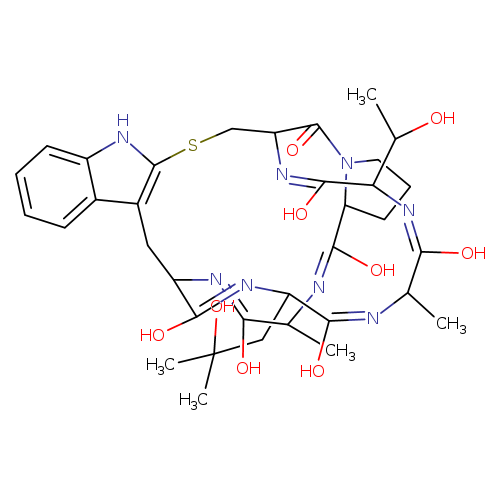
Prophalloin is a solid compound of exogenous origin with the formula C35H48N8O9S. Prophalloin belongs to the amino acids, peptides, and analogues, a subclass of carboxylic acids and derivatives within the organic compounds. With an average molecular weight of 756.87 g/mol, Prophalloin is a heavy molecule.
This compound targets four specific proteins: cytoplasmic 1 actin (ACTB), cytoplasmic 2 actin (ACTG1), alpha skeletal muscle actin (ACTA1), and aortic smooth muscle actin (ACTA2). Phallotoxins bind actin, preventing its depolymerization and poisoning the cell. They bind specifically at the interface between F-actin subunits, locking adjacent subunits together. This mechanism leads to a decrease in the rate constant for the dissociation of actin subunits from filament ends, which essentially stabilizes actin filaments through the prevention of filament depolymerization. Moreover, they inhibit the ATP hydrolysis activity of F-actin.
belongs to the class of organic compounds known as cyclic peptides. Cyclic peptides are compounds containing a cyclic moiety bearing a peptide backbone.
Oral, dermal, inhalation, and parenteral (contaminated drugs). (3)
Mechanism of Toxicity
Phallotoxins bind actin, preventing its depolymerization and poisoning the cell. They bind specifically at the interface between F-actin subunits, locking adjacent subunits together. This leads to a decrease in the rate constant for the dissociation of actin subunits from filament ends, which essentially stabilizes actin filaments through the prevention of filament depolymerization. Moreover, they inhibit the ATP hydrolysis activity of F-actin. (6, 2)
No indication of carcinogenicity to humans (not listed by IARC).
Uses/Sources
Phalloidin is one of a group of toxins from the death cap (Amanita phalloides) known as phallotoxins. (4)
Minimum Risk Level
Not Available
Health Effects
Liver lesions, tachycardia, hypoglycemia, hypotension and electrolyte imbalance with acid- base disturbance (5).
Symptoms
Hypovolemic shock; Gastrointestinal symptoms occur after a latent period and include abdominal pain, vomiting, and watery diarrhea. Neurologic symptoms are related to hepatic failure and may include encephalopathy, somnolence, confusion, coma and seizures (5).
Treatment
Consider gastric lavage and activated charcoal. (1)