Record Information
Version1.0
Creation Date2014-08-29 06:16:04 UTC
Update Date2026-03-31 18:11:25 UTC
Accession NumberCHEM003250
Identification
Common NameCreatine
ClassSmall Molecule
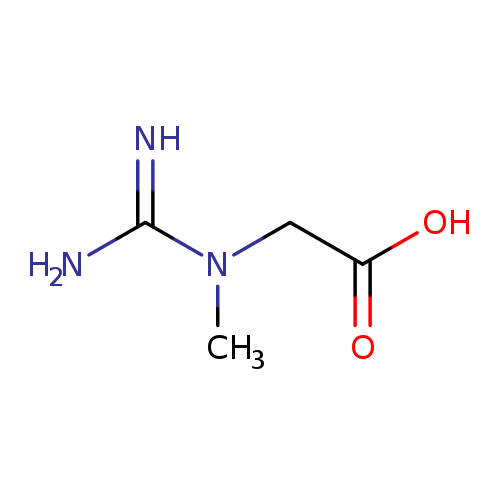
DescriptionCreatine is an amino acid that occurs in vertebrate tissues and in urine. In muscle tissue, creatine generally occurs as phosphocreatine. Creatine is excreted as creatinine in the urine. Creatine functions as part of the cell's energy shuttle. The high energy phosphate group of ATP is transferred to creatine to form phosphocreatine in the following reaction: Cr + ATP <-> PCr + ADP. This reaction is reversibly catalyzed by creatine kinase. In the human body creatine is synthesized mainly in the liver by the use of parts from three different amino acids - arginine, glycine, and methionine. 95% of it is later stored in the skeletal muscles, with the rest in the brain, heart, testes.
Contaminant Sources
  • Cosmetic Chemicals
  • FooDB Chemicals
  • HMDB Contaminants - Urine
  • STOFF IDENT Compounds
  • T3DB toxins
Contaminant Type
  • Amide
  • Amine
  • Animal Toxin
  • Dietary Supplement
  • Drug
  • Food Toxin
  • Household Toxin
  • Metabolite
  • Micronutrient
  • Natural Compound
  • Nutraceutical
  • Organic Compound
  • Supplement
Chemical Structure
Thumb
Synonyms
ValueSource
((Amino(imino)methyl)(methyl)amino)acetic acidChEBI
(alpha-Methylguanido)acetic acidChEBI
(N-Methylcarbamimidamido)acetic acidChEBI
alpha-Methylguanidino acetic acidChEBI
CreatinChEBI
KreatinChEBI
MethylglycocyamineChEBI
N-(Aminoiminomethyl)-N-methylglycineChEBI
N-[(e)-AMINO(imino)methyl]-N-methylglycineChEBI
N-AmidinosarcosineChEBI
N-Carbamimidoyl-N-methylglycineChEBI
N-Methyl-N-guanylglycineChEBI
((Amino(imino)methyl)(methyl)amino)acetateGenerator
(a-Methylguanido)acetateGenerator
(a-Methylguanido)acetic acidGenerator
(alpha-Methylguanido)acetateGenerator
(Α-methylguanido)acetateGenerator
(Α-methylguanido)acetic acidGenerator
(N-Methylcarbamimidamido)acetateGenerator
a-Methylguanidino acetateGenerator
a-Methylguanidino acetic acidGenerator
alpha-Methylguanidino acetateGenerator
Α-methylguanidino acetateGenerator
Α-methylguanidino acetic acidGenerator
Cosmocair C 100HMDB
Creatine hydrateHMDB
KrebiozonHMDB
MethylguanidoacetateHMDB
Methylguanidoacetic acidHMDB
N-(Aminoiminomethyl)-N-methyl-glycineHMDB
PhosphagenHMDB
[[Amino(imino)methyl](methyl)amino]acetateHMDB
[[Amino(imino)methyl](methyl)amino]acetic acidHMDB
Chemical FormulaC4H9N3O2
Average Molecular Mass131.133 g/mol
Monoisotopic Mass131.069 g/mol
CAS Registry Number57-00-1
IUPAC Name2-(N-methylcarbamimidamido)acetic acid
Traditional Namecreatine
SMILESCN(CC(O)=O)C(N)=N
InChI IdentifierInChI=1S/C4H9N3O2/c1-7(4(5)6)2-3(8)9/h2H2,1H3,(H3,5,6)(H,8,9)
InChI KeyCVSVTCORWBXHQV-UHFFFAOYSA-N
Chemical Taxonomy
Description belongs to the class of organic compounds known as alpha amino acids and derivatives. These are amino acids in which the amino group is attached to the carbon atom immediately adjacent to the carboxylate group (alpha carbon), or a derivative thereof.
KingdomOrganic compounds
Super ClassOrganic acids and derivatives
ClassCarboxylic acids and derivatives
Sub ClassAmino acids, peptides, and analogues
Direct ParentAlpha amino acids and derivatives
Alternative Parents
Substituents
  • Alpha-amino acid or derivatives
  • Guanidine
  • Carboximidamide
  • Monocarboxylic acid or derivatives
  • Carboxylic acid
  • Organic nitrogen compound
  • Organic oxygen compound
  • Organopnictogen compound
  • Organic oxide
  • Hydrocarbon derivative
  • Organooxygen compound
  • Organonitrogen compound
  • Imine
  • Carbonyl group
  • Aliphatic acyclic compound
Molecular FrameworkAliphatic acyclic compounds
External Descriptors
Biological Properties
StatusDetected and Not Quantified
OriginEndogenous
Cellular Locations
  • Cytoplasm
  • Extracellular
  • Membrane
  • Mitochondria
Biofluid LocationsNot Available
Tissue Locations
  • Adipose Tissue
  • Bladder
  • Brain
  • Epidermis
  • Fibroblasts
  • Heart
  • Intestine
  • Kidney
  • Muscle
  • Myelin
  • Nerve Cells
  • Neuron
  • Placenta
  • Platelet
  • Prostate
  • Skeletal Muscle
  • Spleen
  • Testes
Pathways
NameSMPDB LinkKEGG Link
Arginine and Proline MetabolismSMP00020 map00330
Glycine and Serine MetabolismSMP00004 map00260
ArgininemiaSMP00357 Not Available
Applications
Biological Roles
Chemical RolesNot Available
Physical Properties
StateSolid
AppearanceWhite powder.
Experimental Properties
PropertyValue
Melting Point255 dec°C
Boiling PointNot Available
Solubility1.33E+004 mg/L (at 18°C)
Predicted Properties
PropertyValueSource
Water Solubility4.11 g/LALOGPS
logP-1.6ALOGPS
logP-2.9ChemAxon
logS-1.5ALOGPS
pKa (Strongest Acidic)3.5ChemAxon
pKa (Strongest Basic)12.43ChemAxon
Physiological Charge0ChemAxon
Hydrogen Acceptor Count5ChemAxon
Hydrogen Donor Count3ChemAxon
Polar Surface Area90.41 ŲChemAxon
Rotatable Bond Count2ChemAxon
Refractivity42.01 m³·mol⁻¹ChemAxon
Polarizability12.17 ųChemAxon
Number of Rings0ChemAxon
Bioavailability1ChemAxon
Rule of FiveYesChemAxon
Ghose FilterNoChemAxon
Veber's RuleNoChemAxon
MDDR-like RuleNoChemAxon
Spectra
Spectra
Spectrum TypeDescriptionSplash KeyView
GC-MSGC-MS Spectrum - GC-EI-TOF (Non-derivatized)splash10-014i-0900000000-7739f1c16da098ff4661Spectrum
GC-MSGC-MS Spectrum - GC-EI-TOF (Non-derivatized)splash10-0002-0900000000-f89f340e776ae37776b3Spectrum
GC-MSGC-MS Spectrum - GC-EI-TOF (Non-derivatized)splash10-014i-0900000000-7739f1c16da098ff4661Spectrum
GC-MSGC-MS Spectrum - GC-EI-TOF (Non-derivatized)splash10-0002-0900000000-f89f340e776ae37776b3Spectrum
Predicted GC-MSPredicted GC-MS Spectrum - GC-MS (Non-derivatized) - 70eV, Positivesplash10-0006-9000000000-4697e8a17788c105f1aaSpectrum
Predicted GC-MSPredicted GC-MS Spectrum - GC-MS (1 TMS) - 70eV, Positivesplash10-00di-9600000000-ef8c833ca7ddb4b1a500Spectrum
Predicted GC-MSPredicted GC-MS Spectrum - GC-MS (Non-derivatized) - 70eV, PositiveNot AvailableSpectrum
Predicted GC-MSPredicted GC-MS Spectrum - GC-MS (TMS_1_2) - 70eV, PositiveNot AvailableSpectrum
Predicted GC-MSPredicted GC-MS Spectrum - GC-MS (TMS_1_3) - 70eV, PositiveNot AvailableSpectrum
Predicted GC-MSPredicted GC-MS Spectrum - GC-MS (TBDMS_1_1) - 70eV, PositiveNot AvailableSpectrum
Predicted GC-MSPredicted GC-MS Spectrum - GC-MS (TBDMS_1_2) - 70eV, PositiveNot AvailableSpectrum
Predicted GC-MSPredicted GC-MS Spectrum - GC-MS (TBDMS_1_3) - 70eV, PositiveNot AvailableSpectrum
LC-MS/MSLC-MS/MS Spectrum - Quattro_QQQ 10V, Positive (Annotated)splash10-000x-9800000000-bc1387ab36f71e04b988Spectrum
LC-MS/MSLC-MS/MS Spectrum - Quattro_QQQ 25V, Positive (Annotated)splash10-0006-9000000000-6c686da36a88d9fbdbcfSpectrum
LC-MS/MSLC-MS/MS Spectrum - Quattro_QQQ 40V, Positive (Annotated)splash10-0006-9000000000-13b7d28e8f5be1c5dadaSpectrum
LC-MS/MSLC-MS/MS Spectrum - LC-ESI-ITFT (LTQ Orbitrap XL, Thermo Scientfic) , Positivesplash10-001i-0900000000-cc4bd4c587dd80f63bcbSpectrum
LC-MS/MSLC-MS/MS Spectrum - LC-ESI-ITFT (LTQ Orbitrap XL, Thermo Scientfic) , Positivesplash10-0udi-3900000000-d35c7578ad50de8377b7Spectrum
LC-MS/MSLC-MS/MS Spectrum - LC-ESI-ITFT (LTQ Orbitrap XL, Thermo Scientfic) , Positivesplash10-000i-9000000000-a4d7fee14f74e1ed8b4bSpectrum
LC-MS/MSLC-MS/MS Spectrum - LC-ESI-ITFT (LTQ Orbitrap XL, Thermo Scientfic) , Positivesplash10-001i-0900000000-e5d62520dfcbf4bfe5c9Spectrum
LC-MS/MSLC-MS/MS Spectrum - LC-ESI-ITFT (LTQ Orbitrap XL, Thermo Scientfic) , Positivesplash10-001i-0900000000-06fbcf897ccce3fa90b7Spectrum
LC-MS/MSLC-MS/MS Spectrum - LC-ESI-ITFT (LTQ Orbitrap XL, Thermo Scientfic) , Positivesplash10-000i-9000000000-9a0b8275e74605a92681Spectrum
LC-MS/MSLC-MS/MS Spectrum - LC-ESI-ITFT (LTQ Orbitrap XL, Thermo Scientfic) , Positivesplash10-000f-9000000000-5f622f2c3de4f213a8edSpectrum
LC-MS/MSLC-MS/MS Spectrum - LC-ESI-ITFT (LTQ Orbitrap XL, Thermo Scientfic) , Positivesplash10-001i-0900000000-20ba65c7a2c9434fcf39Spectrum
LC-MS/MSLC-MS/MS Spectrum - LC-ESI-ITFT (LTQ Orbitrap XL, Thermo Scientfic) , Negativesplash10-01qc-0965022201-53bb6f168e0934ae4a87Spectrum
LC-MS/MSLC-MS/MS Spectrum - LC-ESI-ITFT (LTQ Orbitrap XL, Thermo Scientfic) , Negativesplash10-000i-9000000000-638479794e8c3a6e0b61Spectrum
LC-MS/MSLC-MS/MS Spectrum - LC-ESI-ITFT (LTQ Orbitrap XL, Thermo Scientfic) , Negativesplash10-004i-0900000000-39676937b1a3ad0dc0bcSpectrum
LC-MS/MSLC-MS/MS Spectrum - LC-ESI-ITFT (LTQ Orbitrap XL, Thermo Scientfic) , Negativesplash10-03di-0090000000-d53c75786742ecdb3c16Spectrum
LC-MS/MSLC-MS/MS Spectrum - LC-ESI-ITFT (LTQ Orbitrap XL, Thermo Scientfic) , Negativesplash10-001l-0945022201-2fc3f234454021c5e202Spectrum
LC-MS/MSLC-MS/MS Spectrum - LC-ESI-ITFT (LTQ Orbitrap XL, Thermo Scientfic) , Negativesplash10-000i-9000000000-40aa07f89dddb181e489Spectrum
LC-MS/MSLC-MS/MS Spectrum - LC-ESI-ITFT (LTQ Orbitrap XL, Thermo Scientfic) , Negativesplash10-001i-0900000000-5aca4d0b8ed7d2500af2Spectrum
LC-MS/MSLC-MS/MS Spectrum - LC-ESI-ITFT (LTQ Orbitrap XL, Thermo Scientfic) , Negativesplash10-03di-0190000000-9a9685c32bf6c721a497Spectrum
LC-MS/MSLC-MS/MS Spectrum - LC-ESI-QQ (API3000, Applied Biosystems) 10V, Positivesplash10-001i-1900000000-c99f9492e0b84d5fae6bSpectrum
LC-MS/MSLC-MS/MS Spectrum - LC-ESI-QQ (API3000, Applied Biosystems) 20V, Positivesplash10-0006-9300000000-8ab609e6dd62bd18841fSpectrum
LC-MS/MSLC-MS/MS Spectrum - LC-ESI-QQ (API3000, Applied Biosystems) 30V, Positivesplash10-0006-9000000000-e04e407d5f06d21582c4Spectrum
LC-MS/MSLC-MS/MS Spectrum - LC-ESI-QQ (API3000, Applied Biosystems) 40V, Positivesplash10-0006-9000000000-fd81d06317727fa740b1Spectrum
LC-MS/MSLC-MS/MS Spectrum - LC-ESI-QQ (API3000, Applied Biosystems) 50V, Positivesplash10-0006-9000000000-8428e2af90720afb4337Spectrum
LC-MS/MSLC-MS/MS Spectrum - LC-ESI-QTOF (UPLC Q-Tof Premier, Waters) , Positivesplash10-001i-0900000000-3162b4c94e66796a643bSpectrum
MSMass Spectrum (Electron Ionization)splash10-0006-9100000000-47f885347545055f546dSpectrum
1D NMR1H NMR SpectrumNot AvailableSpectrum
1D NMR13C NMR SpectrumNot AvailableSpectrum
1D NMR1H NMR SpectrumNot AvailableSpectrum
1D NMR13C NMR SpectrumNot AvailableSpectrum
1D NMR1H NMR SpectrumNot AvailableSpectrum
1D NMR13C NMR SpectrumNot AvailableSpectrum
1D NMR1H NMR SpectrumNot AvailableSpectrum
1D NMR13C NMR SpectrumNot AvailableSpectrum
1D NMR1H NMR SpectrumNot AvailableSpectrum
1D NMR13C NMR SpectrumNot AvailableSpectrum
1D NMR1H NMR SpectrumNot AvailableSpectrum
1D NMR13C NMR SpectrumNot AvailableSpectrum
1D NMR1H NMR SpectrumNot AvailableSpectrum
1D NMR13C NMR SpectrumNot AvailableSpectrum
1D NMR1H NMR SpectrumNot AvailableSpectrum
1D NMR13C NMR SpectrumNot AvailableSpectrum
1D NMR1H NMR SpectrumNot AvailableSpectrum
1D NMR13C NMR SpectrumNot AvailableSpectrum
1D NMR1H NMR SpectrumNot AvailableSpectrum
1D NMR13C NMR SpectrumNot AvailableSpectrum
1D NMR1H NMR SpectrumNot AvailableSpectrum
2D NMR[1H,1H] 2D NMR SpectrumNot AvailableSpectrum
2D NMR[1H,13C] 2D NMR SpectrumNot AvailableSpectrum
Toxicity Profile
Route of ExposureNot Available
Mechanism of ToxicityIn the muscles, a fraction of the total creatine binds to phosphate - forming creatine phosphate. The reaction is catalysed by creatine kinase, and the result is phosphocreatine (PCr). Phosphocreatine binds with adenosine diphosphate to convert it back to ATP (adenosine triphosphate), an important cellular energy source for short term ATP needs prior to oxidative phosphorylation.
Metabolism Half Life: 3 hours
Toxicity ValuesNot Available
Lethal DoseNot Available
Carcinogenicity (IARC Classification)No indication of carcinogenicity to humans (not listed by IARC).
Uses/SourcesFor nutritional supplementation, also for treating dietary shortage or imbalance
Minimum Risk LevelNot Available
Health EffectsNot Available
SymptomsNot Available
TreatmentNot Available
Concentrations
Not Available
DrugBank IDDB00148
HMDB IDHMDB0000064
FooDB IDFDB005403
Phenol Explorer IDNot Available
KNApSAcK IDNot Available
BiGG ID34543
BioCyc IDCREATINE
METLIN ID7
PDB IDNot Available
Wikipedia LinkCreatine
Chemspider ID566
ChEBI ID16919
PubChem Compound ID586
Kegg Compound IDC00300
YMDB IDNot Available
ECMDB IDECMDB21412
References
Synthesis Reference

Stefan Weiss, Helmut Krommer, “Process for the preparation of a creatine or creatine monohydrate.” U.S. Patent US5719319, issued September, 1963.

MSDSLink
General References
1. Thalhammer, Franz; Gastner, Thomas. Preparation of creatine, creatine monohydrate and guanidinoacetic acid. Ger. Offen. (2007), 5pp.
2. Sundekilde UK, Poulsen NA, Larsen LB, Bertram HC: Nuclear magnetic resonance metabonomics reveals strong association between milk metabolites and somatic cell count in bovine milk. J Dairy Sci. 2013 Jan;96(1):290-9. doi: 10.3168/jds.2012-5819. Epub 2012 Nov 22.
3. Sun HZ, Wang DM, Wang B, Wang JK, Liu HY, Guan le L, Liu JX: Metabolomics of four biofluids from dairy cows: potential biomarkers for milk production and quality. J Proteome Res. 2015 Feb 6;14(2):1287-98. doi: 10.1021/pr501305g. Epub 2015 Jan 28.
4. O'Callaghan TF, Vazquez-Fresno R, Serra-Cayuela A, Dong E, Mandal R, Hennessy D, McAuliffe S, Dillon P, Wishart DS, Stanton C, Ross RP: Pasture Feeding Changes the Bovine Rumen and Milk Metabolome. Metabolites. 2018 Apr 6;8(2). pii: metabo8020027. doi: 10.3390/metabo8020027.
5. A. Foroutan et al. The Chemical Composition of Commercial Cow's Milk (in preparation)
6. Thalhammer, Franz; Gastner, Thomas. Preparation of creatine, creatine monohydrate and guanidinoacetic acid. Ger. Offen. (2007), 5pp.
7. Schonberger B: [Overactive bladder--which diagnosis investigations are necessary before initiating primary treatment?]. Urologe A. 2003 Jun;42(6):787-92. Epub 2003 Apr 25.
8. Mercimek-Mahmutoglu S, Stoeckler-Ipsiroglu S, Adami A, Appleton R, Araujo HC, Duran M, Ensenauer R, Fernandez-Alvarez E, Garcia P, Grolik C, Item CB, Leuzzi V, Marquardt I, Muhl A, Saelke-Kellermann RA, Salomons GS, Schulze A, Surtees R, van der Knaap MS, Vasconcelos R, Verhoeven NM, Vilarinho L, Wilichowski E, Jakobs C: GAMT deficiency: features, treatment, and outcome in an inborn error of creatine synthesis. Neurology. 2006 Aug 8;67(3):480-4. Epub 2006 Jul 19.
9. McConell GK, Shinewell J, Stephens TJ, Stathis CG, Canny BJ, Snow RJ: Creatine supplementation reduces muscle inosine monophosphate during endurance exercise in humans. Med Sci Sports Exerc. 2005 Dec;37(12):2054-61.
10. McMorris T, Harris RC, Swain J, Corbett J, Collard K, Dyson RJ, Dye L, Hodgson C, Draper N: Effect of creatine supplementation and sleep deprivation, with mild exercise, on cognitive and psychomotor performance, mood state, and plasma concentrations of catecholamines and cortisol. Psychopharmacology (Berl). 2006 Mar;185(1):93-103. Epub 2006 Jan 17.
11. Wang PF, McLeish MJ, Kneen MM, Lee G, Kenyon GL: An unusually low pK(a) for Cys282 in the active site of human muscle creatine kinase. Biochemistry. 2001 Oct 2;40(39):11698-705.
12. Olsen S, Aagaard P, Kadi F, Tufekovic G, Verney J, Olesen JL, Suetta C, Kjaer M: Creatine supplementation augments the increase in satellite cell and myonuclei number in human skeletal muscle induced by strength training. J Physiol. 2006 Jun 1;573(Pt 2):525-34. Epub 2006 Mar 31.
13. Ellington WR: A dimeric creatine kinase from a sponge: implications in terms of phosphagen kinase evolution. Comp Biochem Physiol B Biochem Mol Biol. 2000 May;126(1):1-7.
14. Fredericks S, Murray JF, Bewick M, Chang R, Collinson PO, Carter ND, Holt DW: Cardiac troponin T and creatine kinase MB are not increased in exterior oblique muscle of patients with renal failure. Clin Chem. 2001 Jun;47(6):1023-30.
15. Jiao YF, Okumiya T, Saibara T, Kudo Y, Sugiura T: Erythrocyte creatine as a marker of excessive erythrocyte destruction due to hypersplenism in patients with liver cirrhosis. Clin Biochem. 2001 Jul;34(5):395-8.
16. Subramanian A, Gupta A, Saxena S, Gupta A, Kumar R, Nigam A, Kumar R, Mandal SK, Roy R: Proton MR CSF analysis and a new software as predictors for the differentiation of meningitis in children. NMR Biomed. 2005 Jun;18(4):213-25.
17. Nicholson JK, Buckingham MJ, Sadler PJ: High resolution 1H n.m.r. studies of vertebrate blood and plasma. Biochem J. 1983 Jun 1;211(3):605-15.
18. Sheth NP, Sennett B, Berns JS: Rhabdomyolysis and acute renal failure following arthroscopic knee surgery in a college football player taking creatine supplements. Clin Nephrol. 2006 Feb;65(2):134-7.
19. Jenkins CB, Ghidini A, Spong CY, Eglinton GS, Pezzullo JC, Michejda M: Evaluation of early second trimester maternal serum creatine kinase isoenzyme BB as a marker of poor pregnancy outcome. Fetal Diagn Ther. 1997 Nov-Dec;12(6):356-9.
20. Lukaszuk JM, Robertson RJ, Arch JE, Moyna NM: Effect of a defined lacto-ovo-vegetarian diet and oral creatine monohydrate supplementation on plasma creatine concentration. J Strength Cond Res. 2005 Nov;19(4):735-40.
21. Preen DB, Dawson BT, Goodman C, Beilby J, Ching S: Comparison of erythrocyte and skeletal muscle creatine accumulation following creatine loading. Int J Sport Nutr Exerc Metab. 2005 Feb;15(1):84-93.
22. Poortmans JR, Kumps A, Duez P, Fofonka A, Carpentier A, Francaux M: Effect of oral creatine supplementation on urinary methylamine, formaldehyde, and formate. Med Sci Sports Exerc. 2005 Oct;37(10):1717-20.
23. Yoshizumi WM, Tsourounis C: Effects of creatine supplementation on renal function. J Herb Pharmacother. 2004;4(1):1-7.
24. Harris RC, Almada AL, Harris DB, Dunnett M, Hespel P: The creatine content of Creatine Serum and the change in the plasma concentration with ingestion of a single dose. J Sports Sci. 2004 Sep;22(9):851-7.
25. Mendes RR, Pires I, Oliveira A, Tirapegui J: Effects of creatine supplementation on the performance and body composition of competitive swimmers. J Nutr Biochem. 2004 Aug;15(8):473-8.
26. Bales JR, Higham DP, Howe I, Nicholson JK, Sadler PJ: Use of high-resolution proton nuclear magnetic resonance spectroscopy for rapid multi-component analysis of urine. Clin Chem. 1984 Mar;30(3):426-32.
27. Hultman E, Soderlund K, Timmons JA, Cederblad G, Greenhaff PL: Muscle creatine loading in men. J Appl Physiol (1985). 1996 Jul;81(1):232-7.
28. Dangott B, Schultz E, Mozdziak PE: Dietary creatine monohydrate supplementation increases satellite cell mitotic activity during compensatory hypertrophy. Int J Sports Med. 2000 Jan;21(1):13-6.
29. Hespel P, Op't Eijnde B, Van Leemputte M, Urso B, Greenhaff PL, Labarque V, Dymarkowski S, Van Hecke P, Richter EA: Oral creatine supplementation facilitates the rehabilitation of disuse atrophy and alters the expression of muscle myogenic factors in humans. J Physiol. 2001 Oct 15;536(Pt 2):625-33.
30. Juhn M: Popular sports supplements and ergogenic aids. Sports Med. 2003;33(12):921-39.
31. Burke DG, Chilibeck PD, Parise G, Tarnopolsky MA, Candow DG: Effect of alpha-lipoic acid combined with creatine monohydrate on human skeletal muscle creatine and phosphagen concentration. Int J Sport Nutr Exerc Metab. 2003 Sep;13(3):294-302.
32. Elshenawy S, Pinney SE, Stuart T, Doulias PT, Zura G, Parry S, Elovitz MA, Bennett MJ, Bansal A, Strauss JF 3rd, Ischiropoulos H, Simmons RA: The Metabolomic Signature of the Placenta in Spontaneous Preterm Birth. Int J Mol Sci. 2020 Feb 4;21(3). pii: ijms21031043. doi: 10.3390/ijms21031043.
33. https://www.ncbi.nlm.nih.gov/pubmed/?term=11356982
34. https://www.ncbi.nlm.nih.gov/pubmed/?term=11483809
35. https://www.ncbi.nlm.nih.gov/pubmed/?term=11867929
36. https://www.ncbi.nlm.nih.gov/pubmed/?term=12085493
37. https://www.ncbi.nlm.nih.gov/pubmed/?term=12184144
38. https://www.ncbi.nlm.nih.gov/pubmed/?term=12878267
39. https://www.ncbi.nlm.nih.gov/pubmed/?term=16445883
40. https://www.ncbi.nlm.nih.gov/pubmed/?term=17190852
41. https://www.ncbi.nlm.nih.gov/pubmed/?term=17253521
42. https://www.ncbi.nlm.nih.gov/pubmed/?term=18555535
43. https://www.ncbi.nlm.nih.gov/pubmed/?term=19082141
44. https://www.ncbi.nlm.nih.gov/pubmed/?term=19651674
45. https://www.ncbi.nlm.nih.gov/pubmed/?term=19741514
46. https://www.ncbi.nlm.nih.gov/pubmed/?term=19968328
47. https://www.ncbi.nlm.nih.gov/pubmed/?term=21556832
48. https://www.ncbi.nlm.nih.gov/pubmed/?term=21660517
49. https://www.ncbi.nlm.nih.gov/pubmed/?term=21698493
50. https://www.ncbi.nlm.nih.gov/pubmed/?term=22038587
51. https://www.ncbi.nlm.nih.gov/pubmed/?term=22101931
52. https://www.ncbi.nlm.nih.gov/pubmed/?term=22196490
53. https://www.ncbi.nlm.nih.gov/pubmed/?term=22252611
54. https://www.ncbi.nlm.nih.gov/pubmed/?term=22347384
55. https://www.ncbi.nlm.nih.gov/pubmed/?term=22386973
56. https://www.ncbi.nlm.nih.gov/pubmed/?term=22422801
57. https://www.ncbi.nlm.nih.gov/pubmed/?term=22429992
58. https://www.ncbi.nlm.nih.gov/pubmed/?term=22465051
59. https://www.ncbi.nlm.nih.gov/pubmed/?term=22521466
60. https://www.ncbi.nlm.nih.gov/pubmed/?term=7752905