Record Information
Version1.0
Creation Date2014-08-30 21:04:00 UTC
Update Date2026-05-14 16:54:25 UTC
Accession NumberCHEM003517
Identification
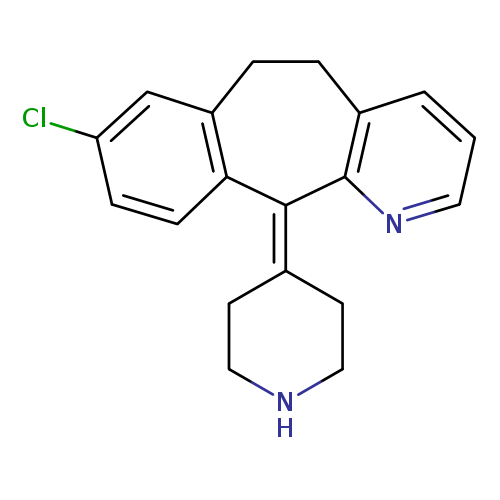
Common NameDesloratadine
ClassSmall Molecule
DescriptionDesloratadine is a second generation, tricyclic antihistamine that which has a selective and peripheral H1-antagonist action. It is the active descarboethoxy metabolite of loratidine (a second generation histamine). Desloratidine has a long-lasting effect and does not cause drowsiness because it does not readily enter the central nervous system.
Contaminant Sources
  • HMDB Contaminants - Urine
  • STOFF IDENT Compounds
  • T3DB toxins
  • ToxCast & Tox21 Chemicals
Contaminant Type
  • Amine
  • Cholinergic Antagonist
  • Drug
  • Histamine Antagonist
  • Histamine H1 Antagonist, Non-Sedating
  • Human Neurotoxin
  • Organic Compound
  • Organochloride
  • Synthetic Compound
Chemical Structure
Thumb
Synonyms
ValueSource
8-Chloro-11-piperidin-4-ylidene-6,11-dihydro-5H-benzo[5,6]cyclohepta[1,2-b]pyridineChEBI
8-Chloro-6,11-dihydro-11-(4-piperidinylidene)-5H-benzo(5,6)cyclohepta(1,2-b)pyridineChEBI
DescarboethoxyloratadineChEBI
ClarinexKegg
DescarboethoxyoratidineHMDB
DesloratidineHMDB
Descarboethoxyloratadine acetateHMDB
NeoclaritynHMDB
AeriusHMDB
Chemical FormulaC19H19ClN2
Average Molecular Mass310.821 g/mol
Monoisotopic Mass310.124 g/mol
CAS Registry Number100643-71-8
IUPAC Name13-chloro-2-(piperidin-4-ylidene)-4-azatricyclo[9.4.0.0^{3,8}]pentadeca-1(11),3(8),4,6,12,14-hexaene
Traditional Nameclarinex
SMILESClC1=CC2=C(C=C1)C(=C1CCNCC1)C1=C(CC2)C=CC=N1
InChI IdentifierInChI=1S/C19H19ClN2/c20-16-5-6-17-15(12-16)4-3-14-2-1-9-22-19(14)18(17)13-7-10-21-11-8-13/h1-2,5-6,9,12,21H,3-4,7-8,10-11H2
InChI KeyJAUOIFJMECXRGI-UHFFFAOYSA-N
Chemical Taxonomy
Description belongs to the class of organic compounds known as benzocycloheptapyridines. These are aromatic compounds containing a benzene ring and a pyridine ring fused to a seven membered carbocycle.
KingdomOrganic compounds
Super ClassOrganoheterocyclic compounds
ClassBenzocycloheptapyridines
Sub ClassNot Available
Direct ParentBenzocycloheptapyridines
Alternative Parents
Substituents
  • Benzocycloheptapyridine
  • Aryl chloride
  • Aryl halide
  • Piperidine
  • Pyridine
  • Benzenoid
  • Heteroaromatic compound
  • Secondary amine
  • Secondary aliphatic amine
  • Azacycle
  • Amine
  • Organonitrogen compound
  • Organochloride
  • Organohalogen compound
  • Organic nitrogen compound
  • Hydrocarbon derivative
  • Organopnictogen compound
  • Aromatic heteropolycyclic compound
Molecular FrameworkAromatic heteropolycyclic compounds
External Descriptors
Biological Properties
StatusDetected and Not Quantified
OriginExogenous
Cellular Locations
  • Membrane
Biofluid LocationsNot Available
Tissue LocationsNot Available
PathwaysNot Available
Applications
Biological Roles
Chemical RolesNot Available
Physical Properties
StateSolid
AppearanceWhite powder.
Experimental Properties
PropertyValue
Melting PointNot Available
Boiling PointNot Available
SolubilityNot Available
Predicted Properties
PropertyValueSource
Water Solubility0.004 g/LALOGPS
logP3.48ALOGPS
logP3.97ChemAxon
logS-4.9ALOGPS
pKa (Strongest Basic)9.73ChemAxon
Physiological Charge1ChemAxon
Hydrogen Acceptor Count2ChemAxon
Hydrogen Donor Count1ChemAxon
Polar Surface Area24.92 ŲChemAxon
Rotatable Bond Count0ChemAxon
Refractivity101.04 m³·mol⁻¹ChemAxon
Polarizability34.35 ųChemAxon
Number of Rings4ChemAxon
Bioavailability1ChemAxon
Rule of FiveYesChemAxon
Ghose FilterYesChemAxon
Veber's RuleYesChemAxon
MDDR-like RuleNoChemAxon
Spectra
Spectra
Spectrum TypeDescriptionSplash KeyView
Predicted GC-MSPredicted GC-MS Spectrum - GC-MS (Non-derivatized) - 70eV, Positivesplash10-00pm-1090000000-22109c83f6d7364ec27fSpectrum
Predicted GC-MSPredicted GC-MS Spectrum - GC-MS (Non-derivatized) - 70eV, PositiveNot AvailableSpectrum
LC-MS/MSLC-MS/MS Spectrum - LC-ESI-qTof , Positivesplash10-08fr-0095000000-2816aba50d0b94d568cfSpectrum
LC-MS/MSLC-MS/MS Spectrum - LC-ESI-qTof , Positivesplash10-08fr-0095000000-5b3f7555b72461661fa1Spectrum
LC-MS/MSLC-MS/MS Spectrum - , positivesplash10-0a4i-0940000000-d20368a648c20c37e1a0Spectrum
LC-MS/MSLC-MS/MS Spectrum - , positivesplash10-08fr-0095000000-2816aba50d0b94d568cfSpectrum
LC-MS/MSLC-MS/MS Spectrum - , positivesplash10-0a4i-0940000000-9a0f5f4d81f4c42c85bbSpectrum
LC-MS/MSLC-MS/MS Spectrum - , positivesplash10-08fr-0095000000-5b3f7555b72461661fa1Spectrum
LC-MS/MSLC-MS/MS Spectrum - LC-ESI-QFT , positivesplash10-0bt9-0094000000-536b5a1d05f7479c2b04Spectrum
LC-MS/MSLC-MS/MS Spectrum - 10V, Positivesplash10-03di-0009000000-4cdd75cfb5b6a95978eeSpectrum
LC-MS/MSLC-MS/MS Spectrum - 35V, Positivesplash10-0a4i-0091000000-702ea1b0afc5802588feSpectrum
LC-MS/MSLC-MS/MS Spectrum - 20V, Positivesplash10-08fr-0094000000-5d18c689b0d8db209b61Spectrum
LC-MS/MSLC-MS/MS Spectrum - 30V, Positivesplash10-0a4i-0090000000-0a46374188b55ae72bbbSpectrum
LC-MS/MSLC-MS/MS Spectrum - 35V, Positivesplash10-0bt9-0094000000-c7895278fdf48ea14ae7Spectrum
LC-MS/MSLC-MS/MS Spectrum - 40V, Positivesplash10-0a4i-0090000000-8a8858c86845b74e96f3Spectrum
LC-MS/MSLC-MS/MS Spectrum - 50V, Positivesplash10-0a4l-0090000000-fe6da9796038e735965fSpectrum
Predicted LC-MS/MSPredicted LC-MS/MS Spectrum - 10V, Positivesplash10-03di-0019000000-1fb53cf6a1a948b66616Spectrum
Predicted LC-MS/MSPredicted LC-MS/MS Spectrum - 20V, Positivesplash10-03di-5098000000-08255511bea5c886b910Spectrum
Predicted LC-MS/MSPredicted LC-MS/MS Spectrum - 40V, Positivesplash10-001i-9040000000-e8c991ebd37a0b0c2544Spectrum
Predicted LC-MS/MSPredicted LC-MS/MS Spectrum - 10V, Negativesplash10-0a4i-0009000000-3a9994f7ccd438482461Spectrum
Predicted LC-MS/MSPredicted LC-MS/MS Spectrum - 20V, Negativesplash10-0a4i-1029000000-5f479948c9e9c3620d41Spectrum
Predicted LC-MS/MSPredicted LC-MS/MS Spectrum - 40V, Negativesplash10-007p-5190000000-6fbaf13ffa17c703d90dSpectrum
Predicted LC-MS/MSPredicted LC-MS/MS Spectrum - 10V, Positivesplash10-03di-0009000000-c678c7bde266b8b7c561Spectrum
Predicted LC-MS/MSPredicted LC-MS/MS Spectrum - 20V, Positivesplash10-03di-0009000000-40e78516a505b8e5b66eSpectrum
Predicted LC-MS/MSPredicted LC-MS/MS Spectrum - 40V, Positivesplash10-0a6s-0190000000-d26af4a5ad57450875acSpectrum
Predicted LC-MS/MSPredicted LC-MS/MS Spectrum - 10V, Negativesplash10-0a4i-0009000000-3adde6a718d7e97498aaSpectrum
Predicted LC-MS/MSPredicted LC-MS/MS Spectrum - 20V, Negativesplash10-053r-9005000000-07072a7bbfb51b942054Spectrum
Toxicity Profile
Route of ExposureNot Available
Mechanism of ToxicityLike other H1-blockers, Desloratadine competes with free histamine for binding at H1-receptors in the GI tract, uterus, large blood vessels, and bronchial smooth muscle. This blocks the action of endogenous histamine, which subsequently leads to temporary relief of the negative symptoms (eg. nasal congestion, watery eyes) brought on by histamine.
Metabolism Route of Elimination: Desloratadine (a major metabolite of loratadine) is extensively metabolized to 3-hydroxydesloratadine, an active metabolite, which is subsequently glucuronidated. Approximately 87% of a 14C-desloratadine dose was equally recovered in urine and feces. Half Life: 50 hours
Toxicity ValuesNot Available
Lethal DoseNot Available
Carcinogenicity (IARC Classification)No indication of carcinogenicity to humans (not listed by IARC).
Uses/SourcesFor the relief of symptoms of seasonal allergic rhinitis, perennial (non-seasonal) allergic rhinitis. Desloratidine is also used for the sympomatic treatment of pruritus and urticaria (hives) associated with chronic idiopathic urticaria.
Minimum Risk LevelNot Available
Health EffectsNot Available
SymptomsNot Available
TreatmentNot Available
Concentrations
Not Available
DrugBank IDDB00967
HMDB IDHMDB0015102
FooDB IDNot Available
Phenol Explorer IDNot Available
KNApSAcK IDNot Available
BiGG IDNot Available
BioCyc IDNot Available
METLIN IDNot Available
PDB IDNot Available
Wikipedia LinkDesloratadine
Chemspider ID110575
ChEBI ID291342
PubChem Compound ID124087
Kegg Compound IDNot Available
YMDB IDNot Available
ECMDB IDNot Available
References
Synthesis Reference

Zoltan Toth, “Processes for preparation of polymorphic forms of desloratadine.” U.S. Patent US20040242619, issued December 02, 2004.

MSDSNot Available
General References
1. Mann RD, Pearce GL, Dunn N, Shakir S: Sedation with "non-sedating" antihistamines: four prescription-event monitoring studies in general practice. BMJ. 2000 Apr 29;320(7243):1184-6.
2. Simons FE, Prenner BM, Finn A Jr: Efficacy and safety of desloratadine in the treatment of perennial allergic rhinitis. J Allergy Clin Immunol. 2003 Mar;111(3):617-22.
3. Glass DJ, Harper AS: Assessing satisfaction with desloratadine and fexofenadine in allergy patients who report dissatisfaction with loratadine. BMC Fam Pract. 2003 Aug 13;4:10. Epub 2003 Aug 13.
4. See S: Desloratadine for allergic rhinitis. Am Fam Physician. 2003 Nov 15;68(10):2015-6.
5. DuBuske L: Desloratadine for chronic idiopathic urticaria: a review of clinical efficacy. Am J Clin Dermatol. 2007;8(5):271-83.
6. Devillier P, Roche N, Faisy C: Clinical pharmacokinetics and pharmacodynamics of desloratadine, fexofenadine and levocetirizine : a comparative review. Clin Pharmacokinet. 2008;47(4):217-30.
7. Bachert C: A review of the efficacy of desloratadine, fexofenadine, and levocetirizine in the treatment of nasal congestion in patients with allergic rhinitis. Clin Ther. 2009 May;31(5):921-44. doi: 10.1016/j.clinthera.2009.05.017.
8. Bachert C, Maurer M: Safety and efficacy of desloratadine in subjects with seasonal allergic rhinitis or chronic urticaria: results of four postmarketing surveillance studies. Clin Drug Investig. 2010;30(2):109-22. doi: 10.2165/11530930-000000000-00000.
9. https://www.ncbi.nlm.nih.gov/pubmed/?term=11844681
10. https://www.ncbi.nlm.nih.gov/pubmed/?term=15482930
11. https://www.ncbi.nlm.nih.gov/pubmed/?term=9934454