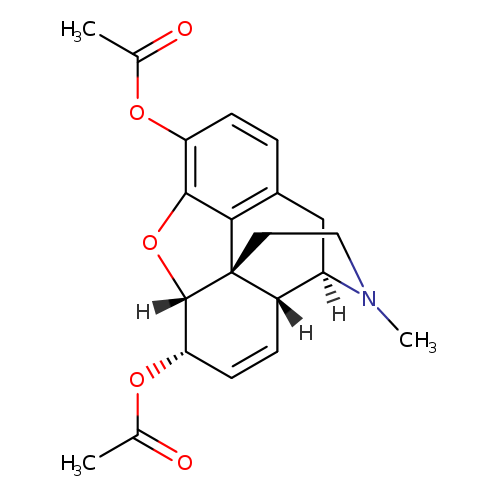
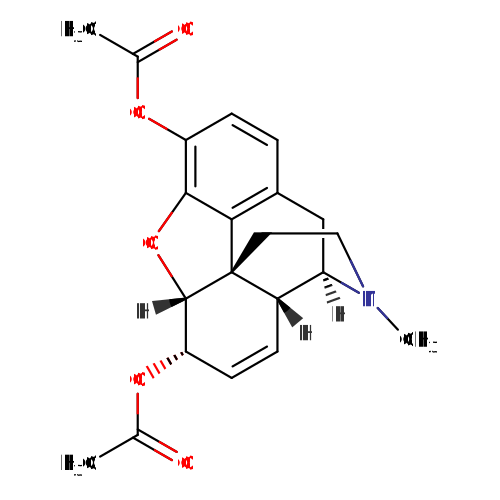
A narcotic analgesic that may be habit-forming. It is a controlled substance (opium derivative) listed in the U.S. Code of Federal Regulations, Title 21 Parts 329.1, 1308.11 (1987). Sale is forbidden in the United States by Federal statute. (Merck Index, 11th ed) Internationally, heroin is controlled under Schedules I and IV of the Single Convention on Narcotic Drugs. It is illegal to manufacture, possess, or sell heroin in the United States and the UK. However, under the name diamorphine, heroin is a legal prescription drug in the United Kingdom.
belongs to the class of organic compounds known as morphinans. These are polycyclic compounds with a four-ring skeleton with three condensed six-member rings forming a partially hydrogenated phenanthrene moiety, one of which is aromatic while the two others are alicyclic.
Heroin is a mu-opioid agonist. It acts on endogenous mu-opioid receptors that are spread in discrete packets throughout the brain, spinal cord and gut in almost all mammals. Heroin, along with other opioids, are agonists to four endogenous neurotransmitters. They are beta-endorphin, dynorphin, leu-enkephalin, and met-enkephalin. The body responds to heroin in the brain by reducing (and sometimes stopping) production of the endogenous opioids when heroin is present. Endorphins are regularly released in the brain and nerves, attenuating pain. Their other functions are still obscure, but are probably related to the effects produced by heroin besides analgesia (antitussin, anti-diarrheal).
Metabolism
Hepatic.
Route of Elimination: 90% renal as glucuronides, rest biliary
Half Life: <10 minutes