Record Information
Version1.0
Creation Date2014-09-11 05:22:42 UTC
Update Date2026-03-27 01:52:51 UTC
Accession NumberCHEM003880
Identification
Common NameFlavone
ClassSmall Molecule
DescriptionQuercetin is a flavonoid that forms the "backbone" for many other flavonoids, including the citrus flavonoids rutin, hesperidin, naringin and tangeritin. In studies, quercetin is found to be the most active of the flavonoids, and many medicinal plants owe much of their activity to their high quercetin content. Quercetin has demonstrated significant anti-inflammatory activity because of direct inhibition of several initial processes of inflammation. For example, it inhibits both the manufacture and release of histamine and other allergic/inflammatory mediators. In addition, it exerts potent antioxidant activity and vitamin C-sparing action.
Contaminant Sources
  • FooDB Chemicals
  • STOFF IDENT Compounds
  • T3DB toxins
  • ToxCast & Tox21 Chemicals
Contaminant Type
  • Ester
  • Food Toxin
  • Metabolite
  • Organic Compound
  • Plant Toxin
  • Synthetic Compound
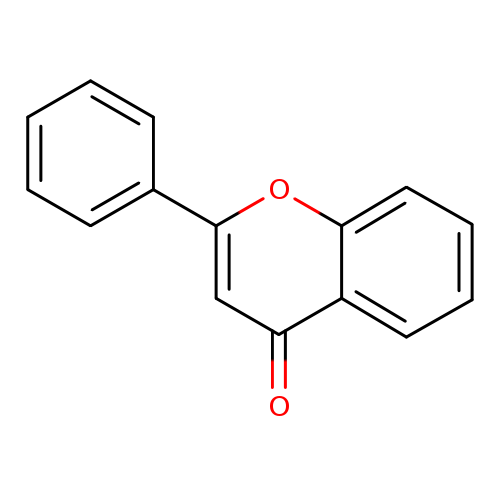
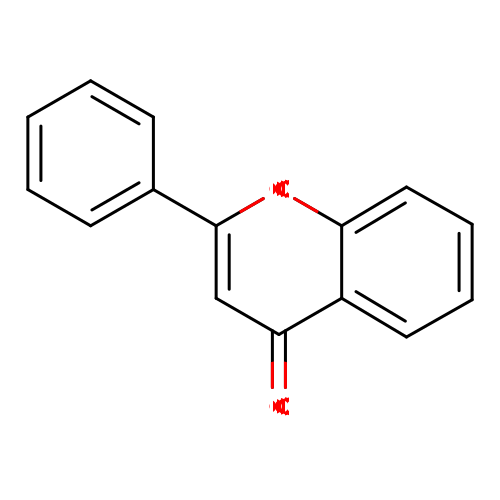
Chemical Structure
Thumb
Synonyms
ValueSource
2-Phenyl-4-benzopyronChEBI
2-Phenyl-4-chromoneChEBI
2-Phenyl-4H-1-benzopyran-4-oneChEBI
2-Phenyl-4H-benzopyran-4-oneChEBI
2-PHENYL-4H-chromen-4-oneChEBI
2-Phenyl-gamma-benzopyroneChEBI
2-Phenylbenzopyran-4-oneChEBI
2-PhenylchromoneChEBI
FlavonChEBI
2-Phenyl-g-benzopyroneGenerator
2-Phenyl-γ-benzopyroneGenerator
Flavone, 14C-labeledMeSH
Chemical FormulaC15H10O2
Average Molecular Mass222.239 g/mol
Monoisotopic Mass222.068 g/mol
CAS Registry Number525-82-6
IUPAC Name2-phenyl-4H-chromen-4-one
Traditional Nameflavone
SMILESO=C1C=C(OC2=CC=CC=C12)C1=CC=CC=C1
InChI IdentifierInChI=1S/C15H10O2/c16-13-10-15(11-6-2-1-3-7-11)17-14-9-5-4-8-12(13)14/h1-10H
InChI KeyVHBFFQKBGNRLFZ-UHFFFAOYSA-N
Chemical Taxonomy
Description belongs to the class of organic compounds known as flavones. These are flavonoids with a structure based on the backbone of 2-phenylchromen-4-one (2-phenyl-1-benzopyran-4-one).
KingdomOrganic compounds
Super ClassPhenylpropanoids and polyketides
ClassFlavonoids
Sub ClassFlavones
Direct ParentFlavones
Alternative Parents
Substituents
  • Flavone
  • Chromone
  • Benzopyran
  • 1-benzopyran
  • Pyranone
  • Benzenoid
  • Monocyclic benzene moiety
  • Pyran
  • Heteroaromatic compound
  • Oxacycle
  • Organoheterocyclic compound
  • Organooxygen compound
  • Organic oxide
  • Organic oxygen compound
  • Hydrocarbon derivative
  • Aromatic heteropolycyclic compound
Molecular FrameworkAromatic heteropolycyclic compounds
External Descriptors
Biological Properties
StatusDetected and Not Quantified
OriginExogenous
Cellular Locations
  • Membrane
Biofluid LocationsNot Available
Tissue Locations
  • Fibroblasts
  • Placenta
  • Prostate
  • Spleen
PathwaysNot Available
ApplicationsNot Available
Biological RolesNot Available
Chemical RolesNot Available
Physical Properties
StateSolid
AppearanceWhite powder.
Experimental Properties
PropertyValue
Melting Point100°C
Boiling PointNot Available
SolubilityNot Available
Predicted Properties
PropertyValueSource
Water Solubility0.0082 g/LALOGPS
logP3.54ALOGPS
logP2.97ChemAxon
logS-4.4ALOGPS
pKa (Strongest Acidic)15.63ChemAxon
pKa (Strongest Basic)-5.4ChemAxon
Physiological Charge0ChemAxon
Hydrogen Acceptor Count2ChemAxon
Hydrogen Donor Count0ChemAxon
Polar Surface Area26.3 ŲChemAxon
Rotatable Bond Count1ChemAxon
Refractivity66.97 m³·mol⁻¹ChemAxon
Polarizability23.79 ųChemAxon
Number of Rings3ChemAxon
Bioavailability1ChemAxon
Rule of FiveYesChemAxon
Ghose FilterYesChemAxon
Veber's RuleYesChemAxon
MDDR-like RuleNoChemAxon
Spectra
Spectra
Spectrum TypeDescriptionSplash KeyView
GC-MSGC-MS Spectrum - GC-MS (Non-derivatized)splash10-00dl-8930000000-3944bcd59fd467475fe4Spectrum
GC-MSGC-MS Spectrum - GC-EI-TOF (Non-derivatized)splash10-00dl-6930000000-af643d33c8bd90e12e34Spectrum
Predicted GC-MSPredicted GC-MS Spectrum - GC-MS (Non-derivatized) - 70eV, Positivesplash10-0fkc-0920000000-128b7f1f2509ae8deed1Spectrum
Predicted GC-MSPredicted GC-MS Spectrum - GC-MS (Non-derivatized) - 70eV, PositiveNot AvailableSpectrum
LC-MS/MSLC-MS/MS Spectrum - Quattro_QQQ 10V, Negative (Annotated)splash10-00di-0190000000-c5dc113240ef2eddc9bcSpectrum
LC-MS/MSLC-MS/MS Spectrum - Quattro_QQQ 25V, Negative (Annotated)splash10-0udi-0900000000-cbc602f9fb305cfab2adSpectrum
LC-MS/MSLC-MS/MS Spectrum - Quattro_QQQ 40V, Negative (Annotated)splash10-0udi-0900000000-1767db1ce89913542708Spectrum
LC-MS/MSLC-MS/MS Spectrum - Linear Ion Trap , negativesplash10-0002-9610000000-8f6ea890ee174ff2cab9Spectrum
LC-MS/MSLC-MS/MS Spectrum - Linear Ion Trap , positivesplash10-00fr-0910000000-f99e5ea29982d8657bf3Spectrum
LC-MS/MSLC-MS/MS Spectrum - Linear Ion Trap , positivesplash10-03di-0390000000-1a1ab6620996a9ddc429Spectrum
LC-MS/MSLC-MS/MS Spectrum - Linear Ion Trap , positivesplash10-00di-0090000000-e8ad16adbd7e6c8dcc23Spectrum
LC-MS/MSLC-MS/MS Spectrum - , positivesplash10-00di-0950000000-94425655598eb5a5cfb4Spectrum
LC-MS/MSLC-MS/MS Spectrum - , positivesplash10-00di-0090000000-dd86946c50229a30d124Spectrum
LC-MS/MSLC-MS/MS Spectrum - , positivesplash10-00di-0490000000-5a3c393a8cf2ea0eac18Spectrum
LC-MS/MSLC-MS/MS Spectrum - LC-ESI-QFT , positivesplash10-00di-0090000000-fbeb1951905acd75fd95Spectrum
LC-MS/MSLC-MS/MS Spectrum - 30V, Positivesplash10-00fr-2930000000-10590084c5f1e791fceaSpectrum
LC-MS/MSLC-MS/MS Spectrum - 10V, Positivesplash10-00di-0090000000-a8f0e8dcf4a988dbb024Spectrum
LC-MS/MSLC-MS/MS Spectrum - 50V, Positivesplash10-004i-7900000000-b112c2a8b645bcbb11beSpectrum
LC-MS/MSLC-MS/MS Spectrum - 10V, Positivesplash10-00di-0190000000-b16f1dc616de8cecfe5cSpectrum
LC-MS/MSLC-MS/MS Spectrum - 10V, Positivesplash10-00di-0190000000-79ffc92ff35f1fa97063Spectrum
LC-MS/MSLC-MS/MS Spectrum - 30V, Positivesplash10-00fr-2930000000-ca1a1360346ad3b18e88Spectrum
LC-MS/MSLC-MS/MS Spectrum - 10V, Positivesplash10-00di-0090000000-eece4fb2fe6b2df673eaSpectrum
LC-MS/MSLC-MS/MS Spectrum - 30V, Positivesplash10-00fr-2930000000-bf2d8022d73944b770e5Spectrum
Predicted LC-MS/MSPredicted LC-MS/MS Spectrum - 10V, Positivesplash10-00di-0090000000-38ca3854c6dc613ef0c9Spectrum
Predicted LC-MS/MSPredicted LC-MS/MS Spectrum - 20V, Positivesplash10-00di-0090000000-e4c89a64e226d0d9d4f5Spectrum
Predicted LC-MS/MSPredicted LC-MS/MS Spectrum - 40V, Positivesplash10-0uk9-9810000000-3db9238369438dc9ba10Spectrum
Predicted LC-MS/MSPredicted LC-MS/MS Spectrum - 10V, Negativesplash10-00di-0090000000-fa65d36bc0c1d13e4df8Spectrum
Predicted LC-MS/MSPredicted LC-MS/MS Spectrum - 20V, Negativesplash10-00di-0090000000-85df3bc42e931d0eb225Spectrum
Predicted LC-MS/MSPredicted LC-MS/MS Spectrum - 40V, Negativesplash10-0v6v-3920000000-0890f524572f69030963Spectrum
MSMass Spectrum (Electron Ionization)splash10-00di-8980000000-8dd4180be084c0205feeSpectrum
1D NMR1H NMR SpectrumNot AvailableSpectrum
2D NMR[1H,13C] 2D NMR SpectrumNot AvailableSpectrum
Toxicity Profile
Route of ExposureNot Available
Mechanism of ToxicityNot Available
MetabolismNot Available
Toxicity ValuesNot Available
Lethal DoseNot Available
Carcinogenicity (IARC Classification)No indication of carcinogenicity to humans (not listed by IARC).
Uses/SourcesIn studies, quercetin is found to be the most active of the flavonoids, and many medicinal plants owe much of their activity to their high quercetin content.
Minimum Risk LevelNot Available
Health EffectsNot Available
SymptomsNot Available
TreatmentNot Available
Concentrations
Not Available
DrugBank IDDB07776
HMDB IDHMDB0003075
FooDB IDFDB006784
Phenol Explorer IDNot Available
KNApSAcK IDC00001040
BiGG IDNot Available
BioCyc IDCPD-8485
METLIN ID3359
PDB IDNot Available
Wikipedia LinkFlavones
Chemspider ID10230
ChEBI ID42491
PubChem Compound ID10680
Kegg Compound IDC15608
YMDB IDNot Available
ECMDB IDNot Available
References
Synthesis ReferenceNot Available
MSDSLink
General References
1. https://www.ncbi.nlm.nih.gov/pubmed/?term=11370674
2. https://www.ncbi.nlm.nih.gov/pubmed/?term=12063116
3. https://www.ncbi.nlm.nih.gov/pubmed/?term=17347140
4. https://www.ncbi.nlm.nih.gov/pubmed/?term=18596412
5. Cummings J, Kerr DJ, Kaye SB, Smyth JF: Optimisation of a reversed-phase high-performance liquid chromatographic method for the determination of flavone acetic acid and its major human metabolites in plasma and urine. J Chromatogr. 1988 Sep 23;431(1):77-85.
6. Choi MH, Kim KR, Hong JK, Park SJ, Chung BC: Determination of non-steroidal estrogens in breast milk, plasma, urine and hair by gas chromatography/mass spectrometry. Rapid Commun Mass Spectrom. 2002;16(24):2221-8.
7. Cai H, Steward WP, Gescher AJ: Determination of the putative cancer chemopreventive flavone tricin in plasma and tissues of mice by HPLC with UV--visible detection. Biomed Chromatogr. 2005 Sep;19(7):518-22.
8. Barrellier MT: [Lymphedema: is there a treatment?]. Rev Med Interne. 1992 Jan-Feb;13(1):49-57.
9. Sengupta B, Uematsu T, Jacobsson P, Swenson J: Exploring the antioxidant property of bioflavonoid quercetin in preventing DNA glycation: a calorimetric and spectroscopic study. Biochem Biophys Res Commun. 2006 Jan 6;339(1):355-61. Epub 2005 Nov 15.
10. Weiss RB, Greene RF, Knight RD, Collins JM, Pelosi JJ, Sulkes A, Curt GA: Phase I and clinical pharmacology study of intravenous flavone acetic acid (NSC 347512). Cancer Res. 1988 Oct 15;48(20):5878-82.
11. Alonso M, Tamasdan C, Miller DC, Newcomb EW: Flavopiridol induces apoptosis in glioma cell lines independent of retinoblastoma and p53 tumor suppressor pathway alterations by a caspase-independent pathway. Mol Cancer Ther. 2003 Feb;2(2):139-50.
12. Ching LM, Joseph WR, Crosier KE, Baguley BC: Induction of tumor necrosis factor-alpha messenger RNA in human and murine cells by the flavone acetic acid analogue 5,6-dimethylxanthenone-4-acetic acid (NSC 640488). Cancer Res. 1994 Feb 15;54(4):870-2.
13. Kim SJ: Effect of biflavones of Ginkgo biloba against UVB-induced cytotoxicity in vitro. J Dermatol. 2001 Apr;28(4):193-9.
14. Lin N, Sato T, Takayama Y, Mimaki Y, Sashida Y, Yano M, Ito A: Novel anti-inflammatory actions of nobiletin, a citrus polymethoxy flavonoid, on human synovial fibroblasts and mouse macrophages. Biochem Pharmacol. 2003 Jun 15;65(12):2065-71.